







ABOUT
:: MATERIALS
In the broadest sense, the
materials used in bicycle frame construction are selected for
their relative combination of properties in three basic
categories: Strength, Weight, and Stiffness. While one can go
into great detail on each of these basic properties, for this
website's needs we will keep things as succinct as possible.

Strength: Perhaps the most basic and universal of the
three terms, this refers to the ratio of absolute weight a
material can support before it fails or becomes permanently
deformed.
It is possible to have an extremely strong frame that handles
terribly, or a frame that handles great but will buckle under
the load of an impact.
Weight: Somewhat of a no-brainer, this refers to how
"heavy" or "light" a specific quantity of
material is. Identical tubes--same diameter, same thickness,
same dimensions--of different materials will have different
weights.
It is possible to build a very light frame through a process of
papier-mâché, but riding it would not be advisable.
Stiffness: The most frequently cited and equally
oft-misunderstood aspect of frame material properties, this
could loosely be considered as a material's flexibility. That is
to say the degree to which a material can be distorted by a load
without being permanently deformed.
It is possible to have a very stiff material with little to no
strength, and conversely to have a very flexible material that
is extremely difficult to break. Consider a piece of uncooked
spaghetti versus a length of string.
Taking those three variables into account--both in absolute
terms as well as in relation to the characteristics for a
specific application--one can arrive at the ideal material for
each individual bike. Depending on the intended use(s) of the
bike, the ideal materials could be metals, synthetic composites,
natural fibers or, as has increasingly been the case, a
combination of several materials.
Even when simplified to the most basic terminology, the
application of frame materials for bicycles can be terribly
complex. Strength is a component of safety and durability moreso
than of handling; stiffness has a more immediate impact on
handling but also factors into durability. Both the relative
strength of a material and its stiffness directly influence
technical details such as tube thickness and diameter, and
weight is an obvious practical consideration as well. Any way
you slice it, the three are intrinsically complimentary when
determining the ride characteristics of a frame.
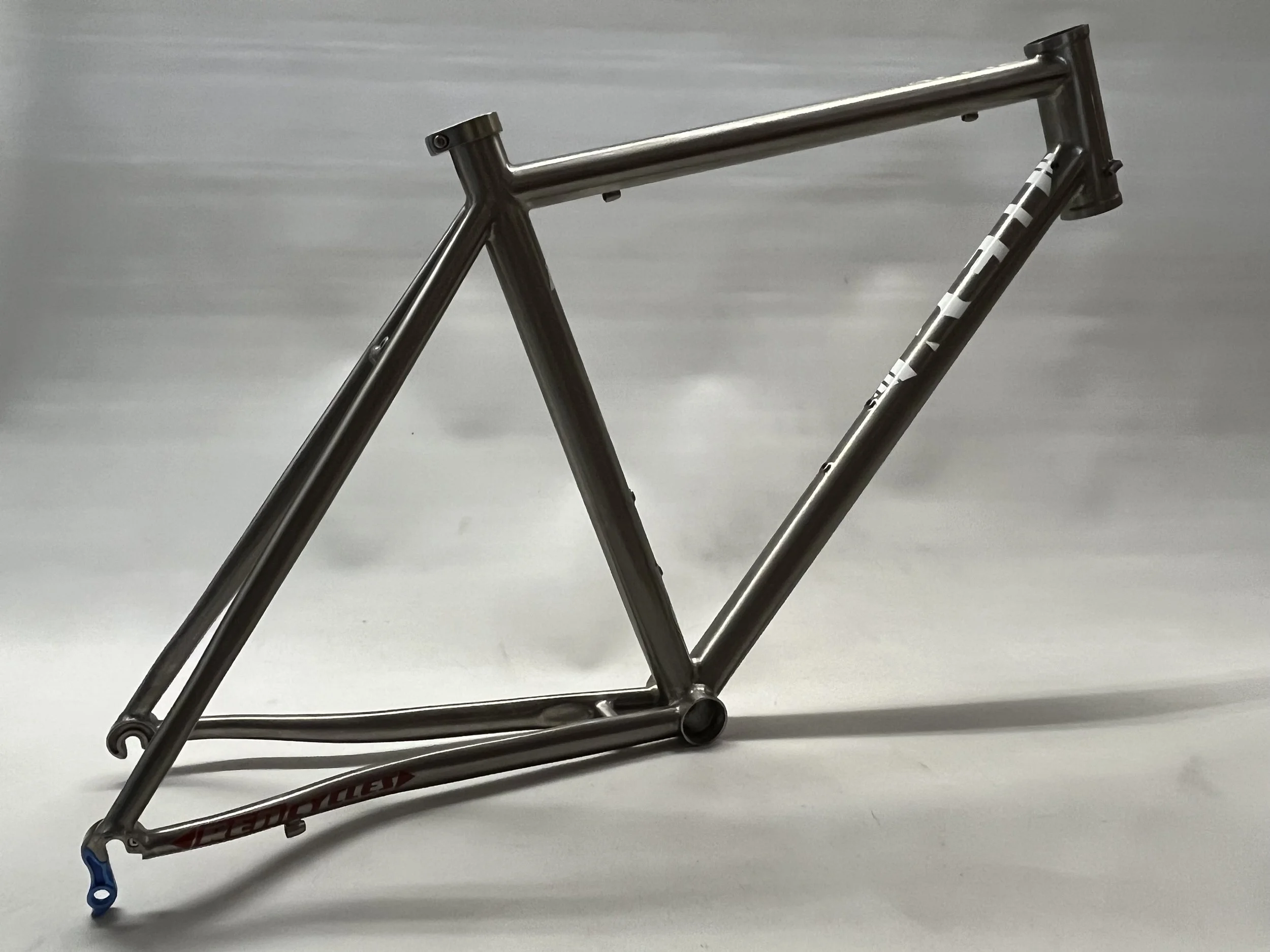
Here at Ti Cycles, we hand-build frames from two primary
materials: Titanium and Steel.

Why Titanium?
Because they make space shuttle parts out of it. Titanium’s
higher strength and lower density allow for the construction of
lighter, higher performance frames.

Why Steel?
Steel, as the saying goes, is real. Though bicycles have been
made from all manner of stock over the years--from exotic
materials like bamboo and hardwood to metal matrix alloys with
unpronouncable names--steel has been the staple of modern bike
fabrication since its inception. And for good reason.
Regardless of the materials you choose, every Ti Cycles bike is
hand-built, from the mitering of tubes to the precision welding
to the assembly and finishing. The attention to detail holds
true for both production and custom-built frames.
 |
|
|